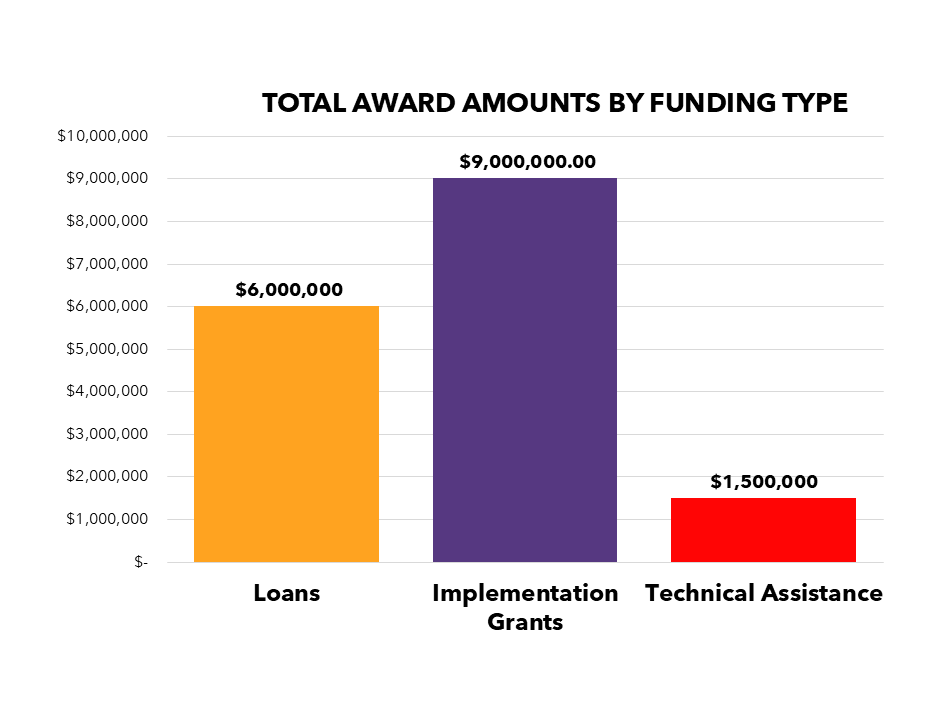
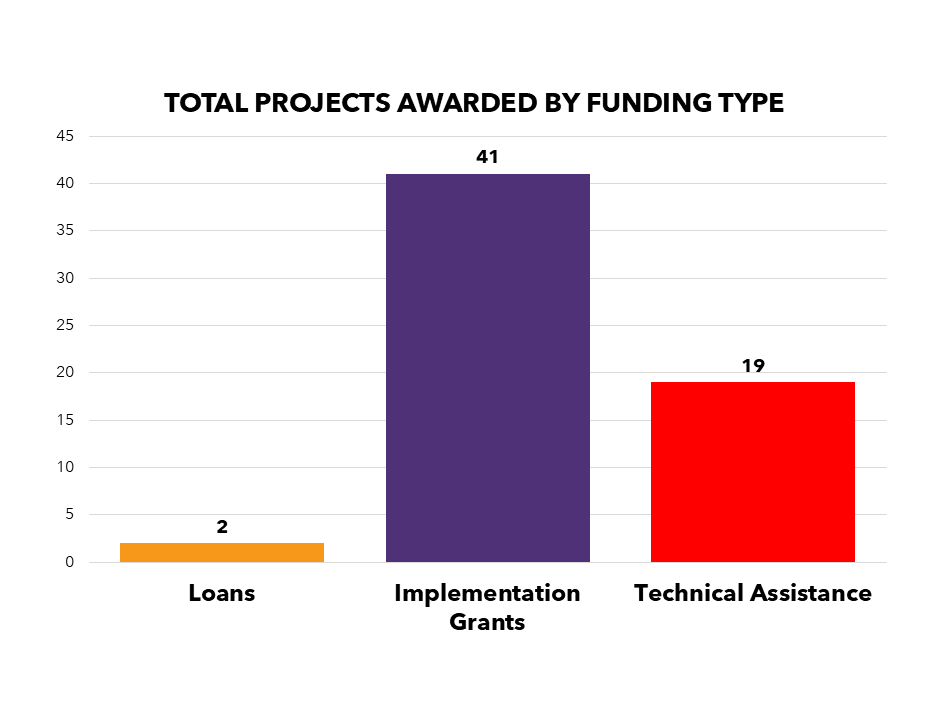
In the 2024-2025 funding cycle, Reinvestment Fund awarded a total of $16.5 million in grants, loans, and technical assistance to 62 projects.
In the 2024-2025 funding cycle, Reinvestment Fund awarded a total of $16.5 million in grants, loans, and technical assistance to 62 projects.
In the 2024-2025 HFFI FARE Fund funding cycle, awardees were located in 42 states.
Read the brief descriptions below to learn more about awardees. Each description includes their location, award amount, and type of funding received.
Location: Grand Rapids, Michigan
Implementation Grant | Grocery store | $131,078
Access of West Michigan is a nonprofit that focuses on systems-level, capacity-building strategies to address the root causes of food insecurity. The organization’s Good Food program brings affordable, culturally relevant, and locally grown produce to underserved neighborhoods through five Fresh Markets – a mix of farm stands, co-ops and other food retail models. Access of West Michigan plans to upgrade three of these existing stores and launch one new market. HFFI funds will be used for construction, refrigeration, marketing materials, and personnel.
Location: Indianapolis, Indiana
Implementation Grant | Grocery store | $228,500
Aspire Higher Foundation, Inc is a nonprofit that operates an urban farm and food distribution, cooking, and youth workforce programs. The organization’s current initiative, Urban Bloom Marketplace Collective, will be a 1,200 square foot social enterprise grocery store model that sells locally grown produce and other staple foods. HFFI funds will be used for a POS system, site construction, and personnel.
Location: Willimantic, Connecticut
Implementation Grant | Grocery store | $250,000
Bob’s Windham IGA is a family-owned supermarket that has served its community since 1984. The store is undertaking a critical remodel and expansion to strengthen fresh food access, affordability, and community resilience. HFFI funds will be used for new retail refrigeration, ensuring the store can continue to sell and expand its selection of locally grown foods.
Location: Louisville, Kentucky
Implementation Grant | Farmers market | $224,650
Change Today, Change Tomorrow Inc. (CTCT) is a nonprofit founded in 2019 to address long-term disparities in food access, health outcomes, and educational opportunities across historically underserved neighborhoods. CTCT currently manages the West End Farmers Market which supports over 40 local farmers, growers and food artisans, as well as other community health and engagement programs. CTCT plans to expand the reach of its farmers market by launching a CSA program and building refrigerated food lockers for community members for 24/7 access. HFFI funds will be used for the purchase and installation of the food lockers, infrastructure equipment for the existing market, CSA, food safety, and marketing consulting, materials for the CSA program, and personnel.
Location: Notasulga, Alabama
Implementation Grant | Grocery store | $250,000
Carmack’s Grocery is an existing local, family-owned grocery store. The proposed project aims to enhance the availability of fresh products, ensuring that Carmack’s Grocery can continue to meet the food access needs of the community. HFFI funds will be used for 11 new, energy efficient refrigeration freezers and coolers.
Location: Madison, Wisconsin
Implementation Grant | Food hub | $200,000
Community Action Coalition for Wisconsin (CAC) is a nonprofit organization fighting hunger, homelessness, and poverty by connecting community members with resources and tools to build social and economic security. Among other food access initiatives, CAC operates a 10,000-square-foot food warehouse that is equipped with dry, refrigerated, and frozen storage and new processing capacity as well as leads the Wisconsin Foodshed Partnership (WFP). WFP is a collaboration of nonprofit and for-profit partners working together to strengthen the local food supply chain that will increase access to affordable, nutritious, and culturally relevant foods year-round at food retail outlets and farmers markets while improving supply chain efficiency and creating new retail market opportunities for local farmers. WFP plans to improve the warehouse’s aggregation, processing, distribution, and retail capacities. HFFI funds will be used for storage and retail equipment, equipment improvements, and marketing materials.
Location: London, Kentucky
Implementation Grant | Farmers market | $250,000
Cornett Farm Fresh, LLC is a family-owned farm market that operates as both a community food retailer and a supply chain anchor for over 60 local vendors and regional farmers. To better serve its community, the store plans to expand cold storage capacity to increase inventory and reduce food waste, increasing both supply of local foods and customer demand. HFFI funds will be used for the purchase and installation of commercial-grade refrigeration units, as well as necessary electrical and structural modifications to maximize cold storage efficiency.
Location: Crescent City, California
Implementation Grant | Grocery store/farmers market/food hub | $246,680
The Del Norte and Tribal Lands Community Food Council (DNATL CFC) is establishing a 15,000 square foot food hub that will provide a place for producers to store, process, aggregate, and distribute locally grown food. The project will also construct a year-round farmers market, grocery store, and a tool lending library. HFFI funds will be used for cold storage equipment, retail fixtures, construction, architectural consulting, and personnel for the new project.
Location: Helena, Arkansas
Implementation Grant | Food co-op | $250,000
Delta Magic is a nonprofit dedicated to economic development and revitalization of its community. In response to a local food desert report, the organization will establish a new, community-owned full-service grocery store called Big River Grocery. The project aims to increase access to healthy foods, catalyze neighborhood revitalization, and local economic opportunity. HFFI funds will be used for architectural designs, construction, and personnel.
Location: Washington, D.C.
Implementation Grant | Grocery store | $197,595
DC Central Kitchen Inc. is a nonprofit organization whose mission is to use food as a tool to strengthen bodies, empower minds, and build communities. The organization operates workforce development, farm-to-school, healthy corner store, and community meals programs, in addition to an urban food hub and culinary training center. DC Central Kitchen plans to add a new retail location that will sell a variety of healthy staple and perishable foods and serve as a wholesale aggregation space for the organization’s healthy corner store program. HFFI funds will be used for architectural designs, project management costs, and personnel.
Location: Florence, South Carolina
Implementation Grant | Grocery store | $216,000
Elijah Craig LLC, dba Community Grocery Store (CGS) is a mission-driven, community-owned supermarket implementing the Farm 2 Store model – connecting minority farmers with underserved communities. The store operates through a hybrid management structure that includes private owners, youth-led retail teams, farmer advisory councils, and a community-based board of directors, with over 352 shareholders. Farm 2 Store is an initiative by CGS that supports local purchasing by providing farmers with in-store access to vegetable processing, packaging, and retail distribution. HFFI funds will be used for site preparation, the purchase of equipment for washing and packaging stations, refrigeration, marketing materials and other small wares.
Location: Gary, Indiana
Implementation Grant | Grocery store | $250,000
Families Anchored in Total Harmony, Inc. is a nonprofit and local Community Development Corporation operating for over 10 years that currently operates an urban farm and orchard, and a Food is Medicine program. The nonprofit plans to establish a community-led and owned grocery store for fresh, healthy, and culturally appropriate foods and medically tailored meals. The store will also strengthen the local supply chain by supporting small regional farmers. HFFI funds will be used for site construction related to the build-out of the store.
Location: Hilo, Hawaii
Implementation Grant | Grocery store | $250,000
The Food Basket, Inc. is a nonprofit that operates emergency food initiatives and a CSA program. The organization is expanding its work within the local food system to establish a permanent, community-centered farmers market: The Ho‘olako Farmers Market. The market will serve as a direct-to-consumer and wholesale outlet connecting Hawaiʻi Island farmers and local families, improving access to affordable, locally produced food while expanding economic opportunity for small and mid-sized agricultural producers. HFFI funds will be used for the construction of the on-site restroom facility.
Location: Cobden, Marion, and Anna, Illinois
Implementation Grant | Mobile market | $222,869
Food Works is a nonprofit that supports small regional farmers through education and market opportunities. The organization also operates a Mobile Farmers Market that provides fresh and healthy foods to rural and low-income communities and aggregates from over 30 local farmers. Food Works will be establishing a centralized Mobile Market Hub to support the expansion of their existing mobile market. HFFI funds will be used for architectural designs, to conduct a Community Food Assessment, for an environmental site evaluation, marketing materials, and personnel.
Location: San Carlos, Arizona
Implementation Grant | Grocery store/farmers market | $250,000
The George Belvado Jr. Memorial Sports Association (GBMSA) is a nonprofit that provides its community with sports and recreation services. GBMSA is located on the San Carlos Apache Reservation and is establishing year-round access to affordable, nutritious, culturally relevant foods through a retail store and seasonal farmers market, as well as providing a produce aggregation and processing commercial kitchen that will supply inventory for the retail store and farmers market. HFFI funds will be used for the purchase of storage and retail refrigeration, commercial kitchen equipment, farmers market supplies, a point-of-sale system, initial inventory, and personnel.
Location: Hagerstown, Maryland
Implementation Grant | Grocery store | $250,000
Hagerstown Goodwill Industries, Inc. is a nonprofit that provides workforce development, job training, and community services regionally, and has been operating for 70 years. The organization will be establishing a full-service grocery store as part of their Fresh Food Initiative. The store will sell a full array of fresh, healthy and culturally appropriate foods as well as host nutrition education classes. HFFI funds will be used to purchase refrigeration and other necessary equipment for the store to open.
Location: Hudson, New York
Implementation Grant | Grocery store/food hub | $137,500
Hawthorne Valley Association, Inc. is a nonprofit with a mission to promote social, ecological, and economic resilience through integrated work in agriculture, education, and the arts. It operates a dairy and vegetable farm, Waldorf School, and two educational centers, as well as a 4,500 sqft farm store that aggregates products from over 200 local and regional vendors. The organization is planning to expand the farm store into a 16,000 square foot natural and organic grocery store and food hub. HFFI funds will be used for a point-of-sale system, contracting a recruiting firm, and a community outreach coordinator.
Location: Smithville, Mississippi
Implementation Grant | Grocery store | $250,000
Holliday’s Helping Hands, Inc. is a California-based, for-profit, real estate development firm dedicated to revitalizing underserved communities through commercial and mixed-use projects. The organization plans to replicate its successful business model to develop its second full-service grocery store, Freshly’s Market. Freshly’s Market will provide fresh produce, meat, dairy, and other grocery staples to a community with no local access to healthy food. HFFI funds will be used for Project predevelopment activities, including project management, architectural and engineering services, environmental and site assessments, entitlement fees, vendor planning, and community engagement.
Location: Lewiston, Maine
Implementation Grant | Grocery store/food hub | $250,000
The Lewiston-Auburn Community Market (LACM) is a multi-stakeholder cooperative neighborhood food complex with a low-cost grocery, commercial kitchens and dry and cold storage. The business model brings healthy and affordable staple and perishable foods and keeps grocery costs low through commercial kitchen rental for business startups and dry and cold storage to subsidize food costs for the neighborhood grocery. HFFI funds will be used for pre-construction project management, and due diligence including market research to inform final design; legal and financial modeling to inform financing; and a building design and community outreach coordinator to build cooperative membership.
Location: Tacoma, Washington
Implementation Grant | Food hub | $250,000
Making a Difference Foundation (MADF) is a nonprofit dedicated to helping individuals meet their basic human needs – food, housing, encouragement, and opportunity. To meet growing demand for fresh and healthy foods, the organization has developed the BIPOC Farm Fresh HUB, which will be a shared-use aggregation, processing, and distribution center that supports small-scale BIPOC farmers while improving food access for underserved communities. The existing space for this operation is in need of critical renovations in order for the project to launch. HFFI funds will be used for end-stage site assessment and renovations.
Location: Pine Ridge Indian Reservation, South Dakota
Implementation Grant | Food hub | $247,500
Makoce Agriculture Development (Makoce) is a community-driven and place-based nonprofit organization. Makoce Agriculture Development is returning to traditional and local foods by building a scalable, non-asset bypass-based Food Hub and viable food system rooted in cultural self determination. This community food hub will support middle-of-the-food-supply chain activities including storage, aggregation, distribution, and retail of locally produced value-added food products, as well as a commercial kitchen. HFFI funds will be used for staff providing project management and strategic partnership development, as well as consultants and staff doing logistics development for a middle-of-the-supply chain food hub sourcing local foods from local producers for distribution at SNAP retailers and institutions on the Pine Ridge Reservation.
Location: Detroit Lakes, Minnesota
Implementation Grant | Food co-op | $55,850
MANNA Food Co-op is a retail, farmer-focused food cooperative founded in 2015 and has been operating a retail storefront since 2017. The store plans to acquire and make significant improvements to a building in downtown Detroit Lakes to expand the store and product mix and improve efficiency. HFFI implementation grant funds will be used for construction costs associated with transforming the 100-year-old building from a hardware store to a licensed retail grocery, namely flooring in the retail space, drywall, and painting.
Location: Holyoke, Massachusetts
Implementation Grant | Farmers market/mobile market | $168,191
Nuestras Raíces is a grassroots urban agriculture organization with a mission to create healthy environments, celebrate “agri-culture,” harness their collective energy, and to advance their vision of a just and sustainable future. Among many food access and agricultural programs, they operate a mobile market, a CSA Program, weekly farmers markets, and an urban farm store. HFFI funds will be used for some project management support and training for staff, purchasing additional technology and point of sale software to manage inventory and sales, marketing and promotional activities and materials, subsidies to create value-added products from unsold produce inventory, planning and strategic development costs, and some support with staffing to develop new partnerships and stops for markets.
Location: Trenton, New Jersey
Implementation Grant | Grocery store | $170,000
Orchid House Café (OHC) is a social enterprise that combines a café, an urban farm, and community initiatives to advance food sovereignty, economic inclusion, and sustainability. The Fig | Mint Cooperative Market is poised to serve as a cooperative grocery and community market co-located with Orchid House Café. HFFI funds will be used for construction planning, architectural design, permitting, project management, and cooperative governance support, including stakeholder onboarding, staff training, and community engagement activities necessary to launch the market.
Location: Flagstaff, Arizona
Implementation Grant | Grocery store | $249,980
The Painted Desert Healthy Food Access and Retail Enhancement Program is a strategic initiative led by Painted Desert Demonstration Projects, Inc. (PDDP), also known as the STAR School. The project addresses significant food insecurity and limited access to fresh, healthy food, particularly within the Navajo Nation and nearby rural communities. The HFFI-funded project is to establish a community grocery store that also supports local producers. HFFI funds will be used for the purchase of retail equipment such as shelving, refrigerators, and a point-of-sale system, as well as initial inventory and consulting services.
Location: Atlanta, Georgia
Implementation Grant | Grocery store | $250,000
Patchwork City Farms (PCF) is an operating urban farm and local farmers market vendor. PCF plans to expand its current operations and develop a Health and Wellness Retail Operation: a 5,000 square foot space incorporating a commercial kitchen, processing and storage center, and a farm store. HFFI funds will be used for construction costs related to the project.
Location: Charlottesville, Virginia
Implementation Grant | Grocery store | $250,000
The 501 Cherry Avenue Grocery Store will be a part of a mixed-use redevelopment of a former supermarket. In partnership with for-profit developer Woodard Properties and the Fifeville Neighborhood Association (FNA), Piedmont Housing Alliance is transforming the nearly 1.4-acre site into a vibrant community hub. The development includes a neighborhood-scale grocery store, a community-focused facility for a nonprofit, and 71 LIHTC-financed affordable apartments. HFFI funds will be used for end-stage predevelopment costs and construction related to opening the new store.
Location: Potsdam, New York
Implementation Grant | Food co-op | $250,000
Since starting as a buying club in 1973, the Potsdam Food Co-op has met the community’s needs for whole, healthy foods with an emphasis on supporting local farmers, processors and producers, offering specialty foods, education, and accessibility. The co-op plans to build a single 4,300-square-foot facility, including 3,000 square feet of retail space, which will enable the expansion necessary to meet rising community demand. HFFI funds will be used for site preparation and construction.
Location: Salina, Kansas
Implementation Grant | Grocery store | $169,270
Prairieland Market is a nonprofit that operates a grocery store and hosts nutrition education opportunities for their community. The store also aggregates inventory from 50 local farmers and ranchers and runs a CSA program. Prairieland Market plans to expand its healthy food offerings through increased market presence. HFFI funds will be used to purchase new retail and commercial kitchen equipment to support increased inventory, conduct marketing and communication initiatives, and support construction and personnel.
Location: Staunton, Virginia
Implementation Grant | Mobile market | $99,862
Project GROWS, Inc. is a nonprofit with the mission of building resilient and accessible local food systems. The organization currently operates an educational farm, mobile market, farmers market and other educational programs. Its retail operations support over 40 local farmers and other small businesses. Project GROWS aims to strengthen the regional food system by expanding its Mobile Market program in three new underserved, rural communities. HFFI funds will be used for marketing materials, additional food processing and community engagement materials, consulting services, and personnel.
Location: Oklahoma City, Oklahoma
Implementation Grant | Grocery store | $250,000
RestoreOKC, Inc. is a community-owned and led nonprofit to address disparities in social determinants of health. Its current initiatives include an urban farm, farmers market, culinary training kitchen, and a full-service grocery store. RestoreOKC, Inc seeks to secure permanent community ownership of The Market at EastPoint, its community-owned grocery store. This acquisition will ensure that the Market remains rooted in the neighborhood, is responsive to community priorities, and is integrated into a broader local food system. HFFI funds will be used for acquisition costs related to the store purchase.
Location: Atlanta, Georgia
Implementation Grant | Grocery store | $250,000
Retaaza LLC is a social enterprise committed to transforming the local food system by enhancing accessibility and affordability. The organization is working to establish a SNAP-accessible food retail market that will offer a diverse selection of staple and perishable foods that are culturally relevant and informed by the local community’s needs. HFFI funds will be used for retrofitting the retail space to create an inviting, functional shopping environment and developing a marketing and promotion strategy to successfully launch the grocery concept with the community’s feedback.
Location: Ambridge, Pennsylvania
Implementation Grant | Food hub | $194,465
RiverWise is a nonprofit launching the Appalachian Food Hub to address systemic food insecurity and revitalize the local food economy in Ambridge Borough – a postindustrial community facing persistent poverty and limited access to healthy food. The Appalachian Food Hub will serve as a centralized facility to aggregate, process, and distribute locally grown food. HFFI funds will support personnel time for overall project management, community and partner engagement, and communications strategy, as well as the predevelopment phase of this effort, including market analysis, business plan development, site feasibility scans, and a fundraising strategy to identify additional funding.
Location: Houston, Texas
Implementation Grant | Farm store | $249,419
Small Places is a nonprofit organization and the owner-operator of Finca Tres Robles, an urban farm that opened in April 2025, that includes an on-site farm store and teaching kitchen. The Finca Tres Robles Neighborhood Farm Store is a community-based food retail project designed to increase access to fresh, affordable food in a predominantly Latino, working-class community. The store sells a wide assortment of locally sourced staple and perishable foods, supported by a tiered pricing model. HFFI funds will be used for equipment, infrastructure, and outreach needed to operate the Finca Tres Robles Neighborhood Farm Store, including commercial refrigeration and freezers, a point-of-sale system, shelving, packaging supplies, marketing and bilingual signage, and consulting support for inventory, pricing, and operational improvements.
Location: Cranston, Rhode Island
Implementation Grant | Food hub | $240,618
Southside Community Land Trust (SCLT) is a nonprofit that operates a food hub, grocery store, and farm which provides 45 farmers with growing space, processing equipment, training and marketing. SCLT aims to expand the food hub by constructing a 4,000 square foot building for processing and cold storage of food grown on-site to be sold at five local retailers. HFFI funds will be used for design and buildout of the building and personnel.
Location: Spokane Valley, Washington
Implementation Grant | Farmers market | $250,000
Spokane Conservation District (SCD) is a local unit of government serving more than 500,000 residents in Spokane County, with a mission to connect people and natural resources through community-driven conservation. In 2017, SCD intentionally acquired a 50-acre former rock quarry – now known as the Quarry Campus – that includes a historic scale house building, which is currently being transformed into Eastern Washington’s first permanent, year-round farmers market and regional food hub called the Scale House Market. HFFI funds will be used for the final phase of construction for the Scale House Market facility, including structural buildout, interior and exterior finishes, and installation of a commercial-grade value added processing kitchen and cold/dry/frozen food storage infrastructure – transforming the site into a permanent, year-round regional food hub.
Location: Huntington, West Virginia
Implementation Grant | Grocery store/food hub | $125,000
Unlimited Future, Inc. (UFI) is a non-profit organization with the mission of supplying people with the tools, resources, and connections to improve their economic status. UFI addresses challenges facing residents in the Huntington Fairfield Neighborhood through its NeighborFood Ecosystem Initiative (NEI), which encompasses a Food & Farm Incubation program, Food Aggregation and Distribution Hub, and The Market@1650 – a year-round farmers’ market and grocery store providing fresh produce and food staples to the community. UFI plans to expand The Market@1650 and improve critical infrastructure failures that threaten UFI’s ability to continue operating the grocery store and food hub. HFFI funds will be used for the purchase and installation of new cold and dry storage to increase the retail space for food items, the replacement of HVAC equipment, purchasing inventory, and hiring and training staff for the market to increase the number of operating hours the store is open.
Location: Rapid City, South Dakota
Implementation Grant | Grocery store/food hub | $250,000
Wambli Ska Community Development Society is a Native-led nonprofit advancing food sovereignty, cultural revitalization, and community wellness. The organization is planning an expansion of an Indigenous-led retail and food hub as a response to an increased need for fresh, healthy, and culturally appropriate foods. The project will establish a grocery store and wholesale supply operation to small grocers. HFFI funds will be used for retail and storage refrigerators, other retail equipment, a point-of-sale system, initial inventory, and personnel.
Location: Salt Lake City, Utah
Implementation Grant | Food co-op | $250,000
Wasatch Cooperative LCA is developing a 5,950-square-foot grocery store, currently with over one thousand member-owners. The goal of the project is to create a reliable market for local producers and artisans while ensuring access to fresh, nutrient-dense food for all community members. HFFI funds will be used for purchasing and installing essential equipment for the co-op’s opening which includes refrigeration and shelving, a check stand, shopping carts and baskets, misting systems, and sinks.
Location: Charlotte, North Carolina
Implementation Grant | Food co-op | $248,237
West Boulevard Neighborhood Coalition (WBNC) is a grassroots nonprofit addressing systemic inequalities to improve access to resources, economic opportunities, and community health. WBNC plans to develop a new grocery co-op called Three Sisters Market in order to meet the needs of a historically underserved community, build local wealth, and support local farmers and producers – many of which are BIPOC and women-owned businesses. HFFI funds will be used for retail refrigeration, a POS system and other equipment, and personnel.
Location: Wooster, Ohio
Implementation Grant | Food co-op | $245,000
Wooster Local Foods Cooperative Inc. is a cooperatively owned and operated local food retail market called Local Roots Market and Cafe, specializing in selling food from micro and small farmers and food producers. Local Roots annually supports 200+ farmers and food producers through for-profit sales, promotion, and community outreach and engagement. After 14 years in its current building, the organization is planning to expand into a larger space. HFFI funds will be used for partial construction of the new site.
Location: Princeton, Missouri
Technical Assistance | Grocery store | $85,644
Apartment on Pine is a residential property development and management business that has begun the process of establishing a new full-service, community-focused grocery store. The organization is working closely with food retail professionals, local farmers, and regional distributors to ensure operational success and community relevance. HFFI funds will be used for consulting services to develop a market analysis, and provide business planning support, financial modeling, and feasibility studies.
Location: St. Louis, Missouri
Technical Assistance | Grocery store | $95,000
A Red Circle (ARC) is a nonprofit dedicated to dismantling racial inequities in its service area by working with communities to identify concerns and implement manageable solutions. ARC is currently in the construction and operations planning phase for a brick and mortar, 10,000 square foot grocery store. HFFI funds will be used for the costs of consultants who will support planning of the brick-and-mortar store, along with a grocery retail consultant who will advise on operations planning, including inventory control, supplier identification, point-of-sale system updates, marketing, government compliance, financial forecasting, and staff training. Funds will also be used to support personnel who will work with these consultants.
Location: Tribal communities in Alaska, Washington, Oregon, and Idaho
Technical Assistance | Food distribution | $85,641
Bristol Bay Regional Seafood Development Association, Inc. (BBRSDA) is a nonprofit that supports the infrastructure, market development, partnership building and quality improvements necessary for the sockeye salmon fishery industry to thrive. BBRSDA is developing the supply chain infrastructure to support a food hub that will distribute an array of staple foods to Native communities in the Pacific Northwest. HFFI funds will be used to contract a business planning servicer to assess the feasibility of and design the project. These activities include identifying aggregation/distribution sites and eligible retailers in these underserved communities.
Location: Johnstown, Pennsylvania
Technical Assistance | Food co-op | $95,000
Center for Population Health (CPH) is a nonprofit that was developed as a population health resource center where data is used to identify community needs, implement new strategies to address them, and measure the results. The goal of this project is to assess the need for fresh food retail options in an underserved, low-income community. HFFI funds will be used to contract a Local Food Systems Coordinator who will oversee site exploration and data collection with the assistance of local university students. In addition, funds will be used for consulting services to support community outreach efforts, and the completion of data analysis, asset mapping, feasibility analysis, and site analysis. Other funds will be used for travel to conferences and to meet with other food systems administrators with which CPH can share ideas and learn from their successes and failures.
Location: Baltimore, Maryland
Technical Assistance | Grocery store | $85,641
Cherry Hill Strong is a resident-led nonprofit and place-based initiative committed to advancing health equity, economic opportunity, and community-driven development. The organization has hosted pop-up produce stands, mobile markets, and a seasonal farmers market. Based on community feedback, the organization is undertaking the establishment of a new, full-service grocery store. HFFI funds will be used to conduct a feasibility study and develop a pro forma for the new store.
Location: Alpena, Michigan
Technical Assistance | Food co-op | $41,000
The Downtown Development Authority (DDA) is part of the city of Alpena local government that focuses on community revitalization. It is the lead organization on a project that will assess the feasibility of establishing a cooperatively owned food retail store. HFFI funds will be used for completing a feasibility study and contracting with professional service providers to assist with legally establishing the co-op, creating a business and funding plan, and completing community engagement and marketing activities to recruit members.
Location: Clay County, West Virginia
Technical Assistance | Grocery store | $84,000
The Clay County Health Department (CCHD) works to prevent disease, promote health, and protect the community from existing health hazards. CCHD is exploring rural grocery models, particularly public-private partnerships, to address local food insecurity by working to identify a sustainable solution for food disparity in the county. Working with a consulting firm, CCHD will evaluate models for rural food retail and delivery, guided by a local advisory board of diverse stakeholders. The project will also engage legal professionals and provide training on rural grocery models and retail food management to support sustainable implementation. HFFI funds will be used for developing and sharing with the community a feasible plan to address food disparity in Clay County. Funds will also cover the cost of travel to two food retail conferences for advisory board members.
Location: Denver, Colorado
Technical Assistance | Grocery store | $60,000
Commún is a nonprofit that currently operates five community-designed programs – food sovereignty, economic vitality, community organizing, mental health, and case navigation – which work together holistically to provide reliable food to residents and reduce the root causes of hunger. The organization recently transitioned its food distribution site to a choice-based market and is planning to further transform it into an equity-based grocery store. HFFI funds will be used for contractors and personnel who will lead completion of community engagement activities, applying for necessary permits and licenses, identifying and solidifying food supplier relationships, completing architectural and design drawings setting up operating and financial systems for the store launch.
Location: Chaparral, New Mexico
Technical Assistance | Grocery store | $95,000
The Little Store #2, Inc is a family-owned grocery store that serves a rural unincorporated community. The Little Store 2 operates as a full-service grocery store, offering a variety of products that range from fresh produce, dairy, meats, to essential household items and dry goods, and partners with local BIPOC and women-owned producers and artisans to supply goods and create economic opportunities. The Little Store #2 seeks to expand and improve store operations. HFFI funds will be used for technical assistance services to provide recommendations and implement strategies related to compliance, vendor management, hiring, culturally relevant inventory planning, community engagement tools, and POS system updates. Funds will also be used for personnel time and travel to support consultants in completing project activities.
Location: Detroit Lakes, Minnesota
Technical Assistance | Food co-op | $20,000
MANNA Food Co-op is a retail, farmer-focused food cooperative founded in 2015 and has been operating a retail storefront since 2017. MANNA Food Co-op’s mission is to foster health and wellness, build a sustainable food system, and support the local economy. MANNA is in the process of acquiring and retrofitting a building to expand the store’s operations, product mix, and improve efficiency. This will not only provide customers with a greater choice of healthy and fresh foods but also expand the sales of nearly 40 local suppliers within 100 miles of the store. HFFI Technical Assistance funds will be used to cover legal fees associated with loan closing costs for the HFFI FARE Fund.
Location: Teller, Alaska
Technical Assistance | Grocery store | $85,644
The federally recognized Native Village of Mary’s Igloo (NVMI) conducts tribal government affairs for their membership in the village of Teller and is governed by the Traditional Council. The Council has been leading the development of a new community and cultural building that will incorporate a grocery store that sells a wide variety of fresh and healthy foods. HFFI funds will be used for consulting services related to developing a feasibility study, business planning services, architectural and engineering support, and developing a design and construction Request for Proposals.
Location: Jacksonville, Florida
Technical Assistance | Grocery store/mobile market | $85,642
New Town Oasis Marketplace, Inc. is a nonprofit dedicated to expanding healthy food access for its community by operating pop-up farm stands, fresh produce distribution, and nutrition education. The organization has evaluated potential sites and conducted community engagement activities for a new community-focused grocery store. HFFI funds will be used for contractual services to complete a feasibility study, Community Food Assessment, business planning and workforce training planning.
Location: Minot, North Dakota
Technical Assistance | Food hub | $95,000
The North Dakota Rural Electric Cooperatives (NDAREC) Foundation is dedicated to enhancing rural quality of life by driving economic growth and improving lives. Its mission is to provide resources that empower communities to seize opportunities, address challenges, and bring visions to life. NDREC is currently exploring a viable and supported business structure and model for a pilot regional grocery warehouse and food hub that will aggregate and distribute conventional groceries and locally produced foods. HFFI funds will be used for costs of food industry, grocery and cooperative development consultants to advance the project from planning to implementation readiness, and personnel to support these activities.
Location: Miami, Oklahoma
Technical Assistance | Grocery store | $40,500
Peoria Tribe of Indians of Oklahoma is a federally recognized Tribal Government that seeks to create a new store that will provide SNAP eligible staple foods for its community. The Peoria Tribe is currently interested in pursuing a feasibility study and developing a more in-depth business model for the project to ensure its extended sustainability and success. HFFI funds will be used to contract two consultants to conduct a feasibility study.
Location: Atlanta, Georgia
Technical Assistance | Grocery store | $85,000
Quest Community Development Organization Inc is a nonprofit affordable housing developer with a mission to create resilient communities and foster social equity through collaboration and service integration. The organization seeks to establish a grocery store at the Quest Westside Impact Center (QWIC), a 30,000-square-foot facility currently serving as a central community hub. HFFI funds will be used for contractual services related to environmental assessments and data analysis, project manager costs, and expenses related to community outreach.
Location: Wilmington, Delaware
Technical Assistance | Grocery store | $85,644
REACH Riverside Development Corporation was formed in 2017 to remove the barriers to prosperity and well-being for local residents, and is leading the implementation of Imani Village, a mixed-income housing project that will incorporate a grocery store. The project is in the predevelopment stage, with a site identified. HFFI funds will be used for consulting services that will conduct a Community Food Assessment and market study to ensure that the project meets the community’s needs.
Location: Memphis, Tennessee
Technical Assistance | Food hub | $85,644
Saxon Palace LLC is a farm and community food enterprise that distributes produce, provides agriculture education to local children, and partners with other organizations on workforce pathway programs. The organization is establishing a community-based, full-service food and retail hub that generates workforce opportunities, with the ultimate goal of advancing healthy equity. HFFI funds will be used for contractual services that will conduct a Community Food Assessment, market study, environmental assessment, financial modeling, and translation services. Other project costs include travel for vendor and community meetings, and personnel.
Location: Los Angeles, California
Technical Assistance | Food co-op | $95,000
SoLA Food Cooperative is led by local residents with expertise in food systems, business development, and community organizing. The co-op currently has over 730 member-owners and is in the planning stage for establishing a new community-owned marketplace and grocery store. HFFI funds will be used to complete the planning documents necessary to attract investment, secure development capital, and determine a location for the store. These include the creation of a comprehensive resource development plan, site planning, and creation of detailed community engagement frameworks. The grant will also help the co-op cultivate relationships with local and national funders, banks, and mission-aligned entrepreneurs.
Location: Shreveport, Louisiana
Technical Assistance | Food hub | $95,000
VLP Alliance is a development firm focused on land development and community-centered solutions. The organization seeks to assess the need for EquiHarvest, a new food hub that reduces food deserts, drives economic development, and supports local producers. HFFI funds will be used for consulting services related to market feasibility, infrastructure planning and business development, as well as personnel and marketing/outreach materials.
Location: Detroit Lakes, Minnesota
Loan | Food co-op | $1,000,000
MANNA Food Cooperative is a retail, farmer-focused food cooperative founded in 2015 and has been operating a retail storefront since 2017. MANNA Food Co-op’s mission is to foster health and wellness, build a sustainable food system, and support the local economy. MANNA is in the process of acquiring and retrofitting a building to expand the store’s operations, product mix, and improve efficiency. HFFI loan funds will be used for building acquisition costs and store equipment.
Location: Madison, Wisconsin
Loan | Grocery store | $5,000,000
Mauer’s Urban Market is working to develop a new 23,479 sqft independent grocery store that will bring fresh, affordable food to Madison’s Bay Creek neighborhood, an underserved area whose only grocery store is closing. The Market will be a leased first floor commercial space of a mixed-use building with affordable housing above the store. The Market owner has been in the grocery business for 15 years and comes from a multigenerational legacy of grocers. HFFI loan funds will be used for equipment purchases and to finalize the buildout of the store.